Table of Contents
Marmorino Plaster: Artisan Finishes for Los Angeles Homes
Marmorino plaster is a traditional Italian lime-based finish valued for its matte, stone-like surface and subtle depth. Unlike Venetian plaster's high-gloss burnish, Marmorino offers a softer, more textured aesthetic. Our artisans also create authentic Venetian plaster Los Angeles for those who prefer a polished, marble-like surface.
We formulate our Marmorino from pure Italian lime putty and natural pigments, never acrylics, so the Italian lime plaster remains breathable and mold-resistant. The National Park Service notes that lime-based plasters have proven durable in historic structures for centuries. Our artisans hand-trowel each application, producing a one-of-a-kind Marmorino finish with rich tonal variation. This traditional Italian plaster regulates indoor moisture naturally, helping walls stay dry even in humid bathrooms.
Marmorino holds up well in damp spaces; when properly sealed, it is an ideal choice for marmorino bathroom walls in Los Angeles homes. We also install this lime-based plaster on fireplace surrounds, accent walls, and living areas throughout Greater Los Angeles. Our team adjusts application techniques to the region's climate, guaranteeing durable, low-maintenance surfaces tailored to local conditions.
Every project begins with a free estimate and an expansive palette of custom color samples. We source the highest quality material directly from Italy and uphold transparency from initial consultation to final burnish. Our artisans hand-craft each surface, free from acrylic shortcuts. Contact us to explore our Marmorino portfolio in Los Angeles and discover the lasting beauty of a genuine lime-based finish.
Understanding Marmorino Plaster: Materials and Core Benefits
Beyond traditional Venetian plaster, Marmorino plaster offers a breathable, stone-like alternative. Made from slaked lime, marble flour, and natural pigments, this authentic Italian lime plaster creates walls with a soft matte to lightly polished texture. Our Los Angeles artisans apply genuine Italian Marmorino using layered trowel techniques. For a polished mirror-like finish, our Venetian plaster services deliver that effect.
The following table compares Marmorino with standard Venetian plaster and painted drywall across key performance and aesthetic dimensions:
| Feature | Marmorino Plaster | Venetian Plaster | Standard Drywall + Paint |
|---|---|---|---|
| Composition | Slaked lime, marble flour, natural pigments | Slaked lime, very fine marble dust | Gypsum board, latex paint |
| Texture | Soft, matte to stone-like; can be coarse or polished | Glass-smooth, polished, often glossy | Flat, uniform, no natural variation |
| Breathability | Highly breathable; regulates humidity | Moderately breathable | Non-breathable; can trap moisture |
| Durability | Very durable, resists scuffs, re-finishable | Durable but shows burnishing wear | Easily dented, requires painting |
| Moisture Resistance | Water-resistant with proper sealer; suits bathrooms | Moderate; not recommended for wet areas without enhanced sealer | Not moisture-resistant; prone to mold |
| Cost (materials + labor) | $14-$16/sq.ft. (L.A. artisan rates) | $12-$20/sq.ft. depending on finish | $2-$5/sq.ft. |
| Maintenance | Dust/vacuum, occasional damp cloth; reseal every few years | Gentle cleaning, avoid harsh chemicals | Repaint every 3-5 years |
Marmorino's standout characteristic is its breathability. The table confirms that it regulates indoor humidity, minimizing mold and condensation. According to National Park Service preservation guidance, traditional lime plasters like Marmorino promote moisture regulation and building longevity. In Los Angeles, this means healthier interiors and reduced risk of trapped dampness.
Durability sets Marmorino apart from standard drywall. The comparison shows that Marmorino resists scuffs and can be re-finished if damaged, while painted drywall dents easily and demands a fresh coat every few years. Our Marmorino plaster surfaces remain intact for decades, and minor flaws can be repaired without stripping the entire finish.
When sealed, Marmorino bathroom walls excel in high-humidity environments. Our breathable sealer preserves the plaster's vapor-open quality while blocking steam, making it suitable for steam showers, powder rooms, and any wet area where painted drywall typically fails.
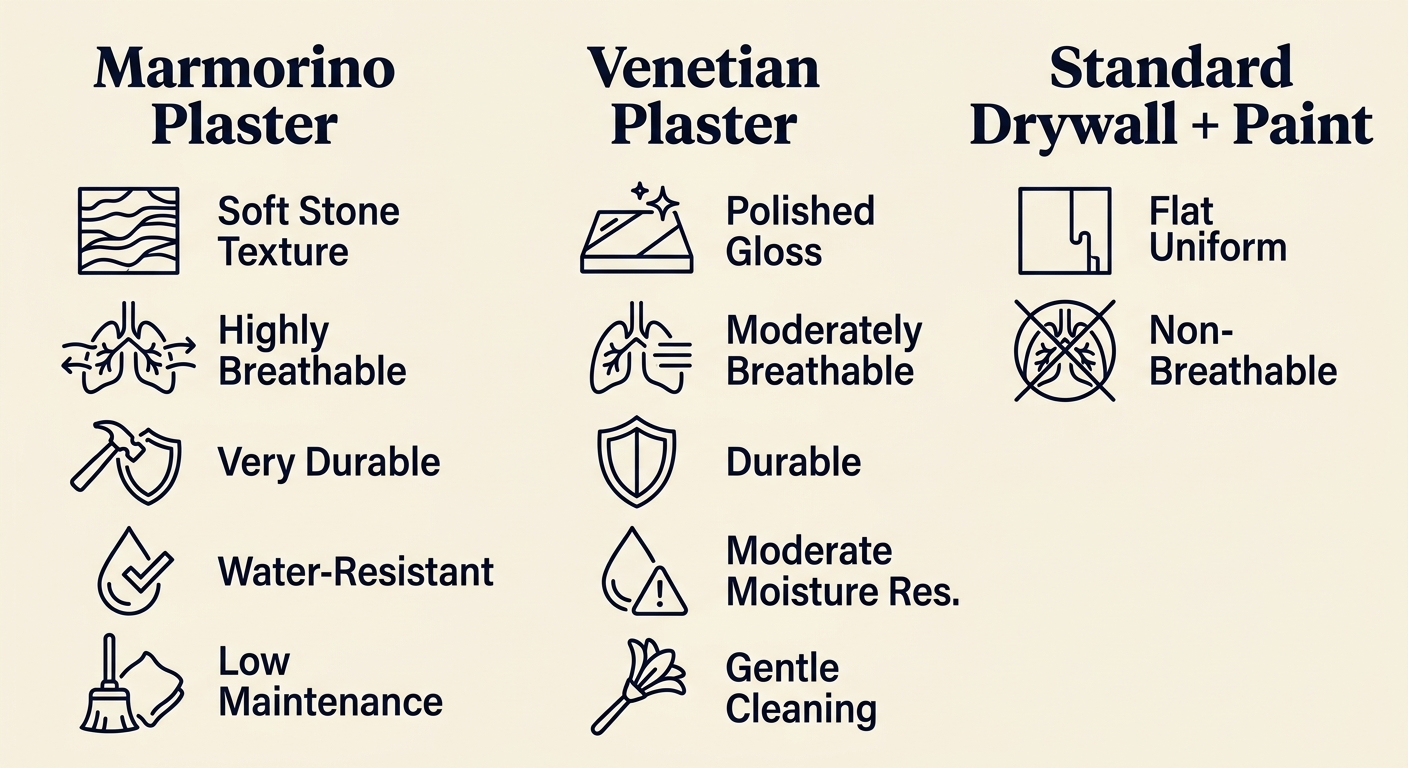
Cost and maintenance considerations further distinguish Marmorino. With typical installation rates of $14-$16 per square foot in the Los Angeles area, Marmorino sits above painted drywall but delivers long-term savings through avoided repaints. Routine care is simple: dusting and occasional damp wiping, plus a reseal every few years. We offer free estimates so clients can evaluate the investment for their specific space.
Now that we understand Marmorino's composition and core benefits, we can explore how this versatile material is applied to create custom finishes.
Advanced Application Techniques and Wet-Area Performance
Now that we understand the essential properties of Marmorino, let's explore advanced application techniques and its remarkable performance in wet environments. Achieving a flawless, marble-like surface with marmorino plaster requires layered precision, artisan skill, and attention to curing times--and with proper sealing, these finishes can thrive in bathrooms and showers, too.
Layering and Burnishing for Authentic Marmorino Finishes
A genuine Marmorino installation is never a single coat. Our artisans at Venetian Plaster Los Angeles follow a strict multi-layer sequence to build depth, strength, and that signature stone-like translucence. The process begins with a primer or scratch coat that bonds the plaster to the substrate and establishes a uniform base. After allowing a 24-hour cure, we apply the first basecoat of Italian lime plaster, troweled evenly to fill any minor irregularities. A second basecoat is then applied, typically after another 24 to 48 hours, to develop the color body and start the transition from flat coverage to subtle texture.
Only when both basecoats are fully dry do we move to the final and most expressive stage: the burnishing coat. This thin, pigment-rich layer is troweled on and immediately worked with a stainless steel spatula in technique we call marmorino spatolato. The spatula presses the lime particles into a compact, glossy surface, eliminating aggregate voids and creating the characteristic marble-like sheen. The burnishing step not only produces a visually refined finish but also increases surface hardness, sealing the pores naturally. This dedication to authentic Italian-origin Marmorino--never acrylic substitutes--ensures the material responds correctly to the spatula and develops the enduring patina our clients expect.
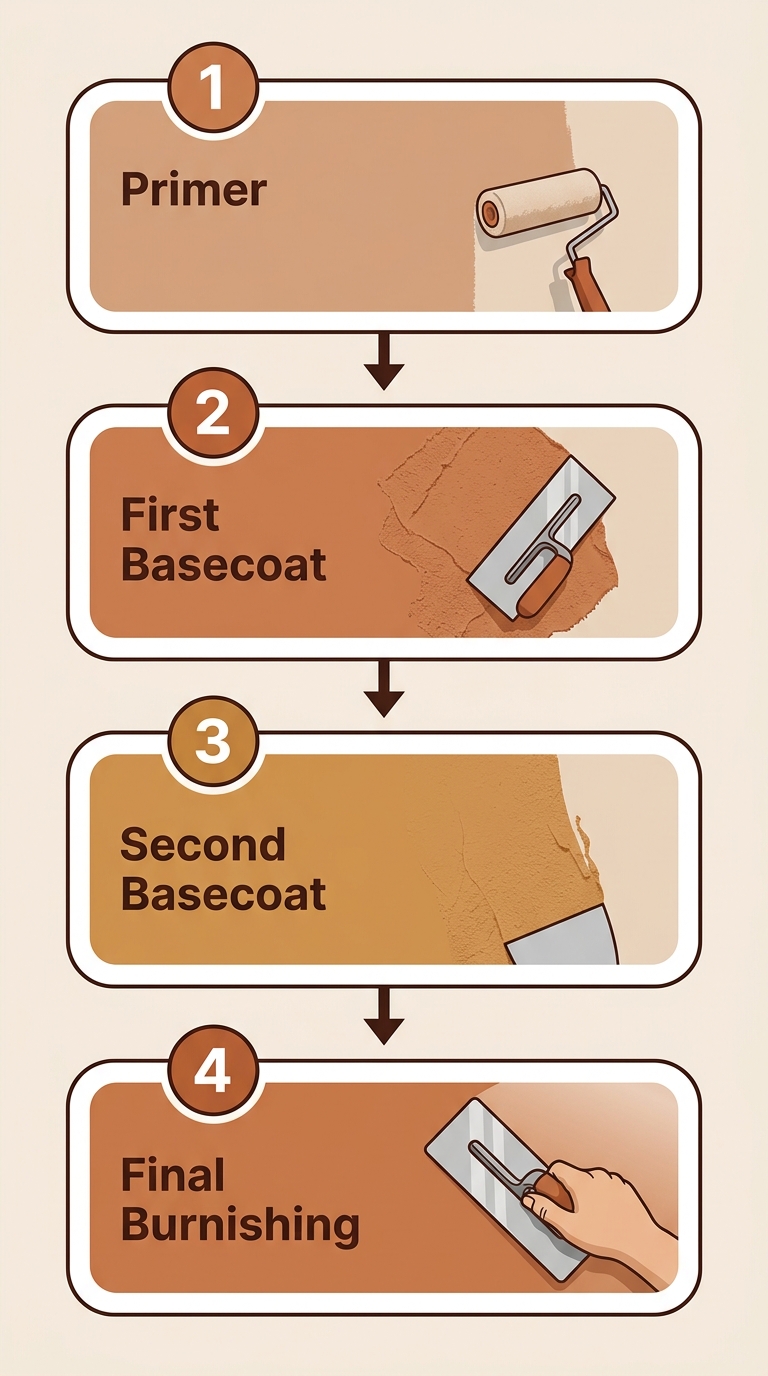
The entire sequence, from primer to final burnish, respects the lime's natural curing rhythm. Rushing the process can trap moisture and compromise both adhesion and the delicate interplay of color and light. By observing adequate cure windows, we allow the plaster to carbonate fully--a slow reaction with atmospheric carbon dioxide that ultimately gives Marmorino its stone-like durability. The result is a surface that not only looks like polished limestone but performs like it, ready to withstand years of use.
Using Marmorino in High-Moisture Environments
Marmorino plaster's compatibility with bathrooms and showers surprises many homeowners. Lime-based plasters are inherently breathable and naturally alkaline, with a pH high enough to inhibit the growth of mold and mildew. However, this resistance only activates when the plaster is fully cured and protected by an appropriate sealer. Without a properly chosen sealer, persistent moisture can penetrate the surface, leading to discoloration or, in extreme cases, plaster degradation.
Choosing the right sealer depends on the moisture level and desired aesthetic. The following table compares the most common sealer types for marmorino bathroom walls, helping you understand the trade-offs between natural appearance, water protection, and long-term maintenance.
| Sealer Type | Waterproof Level | Finish Appearance | Maintenance | Best For |
|---|---|---|---|---|
| Penetrating Silane/Siloxane | High - repels water within the plaster pores | Natural matte, no sheen change | Reapply every 3-5 years | Shower walls, high-humidity bathrooms |
| Topical Polyurethane Sealer | Very high - forms a film | Slight satin sheen; can feel plastic-like | Durable, clean with mild cleanser; may need professional reapplication | High-traffic bathroom walls, commercial settings |
| Wax-Based Sealer (e.g., carnauba) | Low-moderate - water-repellent but not fully waterproof | Soft, burnished sheen; very natural | Requires annual re-waxing in wet zones | Powder rooms or feature walls with occasional splashes |
For a full shower surround, we recommend a penetrating silane/siloxane sealer. It works within the plaster pores to repel water while preserving the authentic matte finish and breathability of the Italian lime plaster. Wax-based sealers, by contrast, are better suited to powder rooms or accent walls that see only occasional splashes; they cannot provide the continuous waterproof barrier a shower demands. Topical polyurethane sealers offer the highest level of protection and are ideal for high-traffic commercial restrooms, though they do introduce a slight sheen and a film-like feel.
As the National Park Service's Preservation Brief 22 advises, traditional lime-based stuccoes and plasters require carefully selected sealers to manage moisture in humid environments without trapping water within the wall assembly. At Venetian Plaster Los Angeles, we apply the same principle to modern residential marmorino bathroom walls, pairing authentic, imported materials with tested sealer systems to deliver a surface that is both beautiful and reliably waterproof.
With these application and sealing techniques in hand, homeowners can confidently plan their Marmorino installation--from the first trowel stroke to the final protective coat.
Cost, Maintenance, and Everyday Durability of Marmorino Walls
Now let's talk about the practical side--what it really costs and how to keep it beautiful for decades. Proper preparation is the foundation for a flawless Marmorino installation, so we begin every project with a thorough wall assessment.
Preparing Walls for Marmorino Installation
We insist on a stable, clean, and dry substrate before any Marmorino is applied. Wallpaper, loose paint, and old adhesives must be completely removed; even a thin layer of dust can compromise the bond. If the surface isn't perfectly smooth, we apply a lime-compatible skim coat to fill minor imperfections and create a uniform base. This step is non-negotiable--skipping it can lead to visible trowel marks or cracks later.
Equally critical is the primer. We never use acrylic or gypsum-based products that would seal the wall and block the plaster's natural breathability. Instead, we apply a high-quality lime-compatible primer that locks in adhesion while allowing moisture vapor to pass through. This ensures the Marmorino cures properly, achieves full hardness, and develops the depth of color that defines a genuine Italian finish.
The Step-by-Step Marmorino Application Process
After the primed wall is ready, we mix pre-bagged Marmorino powder with clean water to a specific consistency--no shortcuts with acrylic additives. Our artisans then spread a rough first coat (the scratch coat) with a steel trowel, pressing firmly to embed the material into the primer. That layer is left to cure, creating a key for the next pass.
Once cured, we apply a second, thinner coat of authentic Italian lime plaster, smoothing it to a fine, even surface. At this stage the plaster is still workable, so we introduce the texture--a light trowel stippling or cross-hatch pattern--that gives Marmorino its signature organic movement. Finally, we burnish the surface with a stainless steel spatula. The friction compresses the marble-dust particles into a subtle, natural sheen without the need for wax or synthetic finish.
We often say that the difference between a DIY attempt and a professional installation is night and day. While a skilled homeowner can mix and trowel, only an experienced artisan can achieve the uniform density, consistent burnish, and flawless color that come from years of training. Our team handles everything from color matching to final sealer, using the highest quality material directly from Italy to create unique decorative walls that stand apart from factory-made alternatives.
Cost Transparency and Long-Term Care for Marmorino Surfaces
To help you set realistic budgets, here's a side-by-side comparison of popular decorative wall finishes available in Los Angeles. When considering marmorino plaster in Los Angeles, the installed cost typically ranges from $14 to $16 per square foot--a figure that reflects both premium Italian materials and the hands of trained artisans.
| Finish Type | Material Origin | Approx. Installed Cost (per sq.ft.) | Expected Lifespan | Maintenance Frequency |
|---|---|---|---|---|
| Marmorino Plaster | Italian lime + marble | $14-$16 | 50+ years with care | Dust; occasional damp wipe; reseal every 3-5 years |
| Venetian Plaster | Italian lime + fine marble dust | $12-$20 | 30-50 years | Gentle cleaning; avoid abrasives |
| Microcement | Polymer-modified cement | $15-$25 | 20-30 years | Wipe with neutral cleaner; may need top coat refresh |
| Tadelakt | Moroccan lime plaster | $20-$30 | 50+ years with olive-soap maintenance | Monthly olive-soap treatment in wet areas |
| Faux Painting | Acrylic paints/glazes | $8-$15 | 10-15 years before repainting | Clean with mild soap; touch-up paint as needed |
While Marmorino's $14-$16 per square foot may seem higher than faux painting, its 50-year lifespan makes it the most cost-effective option over time. Government preservation guidelines from the National Park Service confirm that traditional lime-based plasters, properly maintained, can last half a century or more--outpacing many modern alternatives.
Beyond the upfront investment, real Venetian plaster and Marmorino demand very little day-to-day attention. We recommend dusting with a soft microfiber cloth or a vacuum brush attachment to keep the surface clean. For occasional deeper cleaning, a barely damp cloth with a mild pH-neutral soap is all that's needed; never use vinegar, bleach, or abrasive pads. Reapplying a breathable wax or sealer every three to five years not only renews the subtle luster but also reinforces the water resistance. Marmorino bathroom walls require minimal upkeep--simply wipe down standing water after showers to preserve the sealed finish. With proper care, marmorino plaster retains its elegant depth for decades, proving that an artisan finish is as practical as it is beautiful. If you're ready to invest in a surface that blends Italian craftsmanship with long-term value, contact Venetian Plaster Los Angeles for a free estimate and sample consultation.
Exterior Applications, Longevity, and Bespoke Marmorino Solutions
While marmorino plaster excels indoors, it is equally suited for exterior walls when properly formulated and sealed. In Los Angeles's Mediterranean climate, we adjust the mix with coarser aggregates and pozzolanic additives to boost weather resistance. We rely on the same time-honored Italian materials and techniques that have protected buildings for centuries, ensuring your exterior Marmorino finish remains both beautiful and structurally sound.
Before selecting a finish, it's crucial to understand how interior and exterior requirements differ. The table below outlines key differences in formulation, breathability, and maintenance for interior versus exterior Marmorino in Southern California's climate, helping you choose the appropriate mix and sealer for long-lasting results.
| Factor | Interior Application | Exterior Application |
|---|---|---|
| Formulation | Standard lime-marble mix; can be polished or matte | Often coarser aggregate added for texture; may include pozzolanic additives for weather resistance |
| Breathability | Excellent; regulates indoor humidity | Critical; prevents trapped moisture that leads to spalling |
| Sealer Requirement | Penetrating sealer for wet areas; wax or matte sealer for walls | Water-repellent silane/siloxane applied after full cure; must allow vapor transmission |
| Color Stability | Excellent; minimal UV exposure | Natural pigments may fade slightly over decades; can be refreshed with limewash |
| Maintenance Cycle | Dusting, occasional damp wipe, reseal every 3-5 years | Inspect annually, clean with low-pressure water, reapply sealer as needed |
| Typical Lifespan | 50+ years | 50-75 years with proper maintenance |
The contrast in sealer requirements and maintenance cycles illustrates why exterior Marmorino must be treated differently. Our team accounts for these factors from the initial mix design to the final protective coating, ensuring the plaster thrives in Los Angeles's sun and occasional rain.
Our artisans apply each coat by hand, building up a monolithic lime shell that bonds tenaciously to masonry substrates. Exterior marmorino plaster maintains its integrity for 50 to 75 years, according to the National Park Service's preservation guidelines, assuming regular care. With proper annual inspections and low-pressure water cleaning, the surface resists cracking and spalling, while vapor-permeable sealers allow moisture to escape. In our experience, Los Angeles homeowners who follow this simple annual schedule enjoy decades of trouble-free performance. Natural pigments may fade slightly over decades but can be refreshed with a compatible limewash. To tailor the look to your property, we offer bespoke Marmorino solutions--custom colors and textures that complement your home's architecture and the LA climate. Whether you need a breathable finish for exterior facades or durable marmorino bathroom walls inside, authentic Italian lime plaster delivers enduring elegance. For high-moisture outdoor features, however, Tadelakt offers an alternative solution, which we cover next.
Common Queries About Marmorino Plaster
We often hear these common questions from homeowners about marmorino plaster.
What is Marmorino plaster? Marmorino is a traditional Italian lime plaster made from slaked lime and marble dust, not synthetic. We import the highest quality material directly from Italy.
Is Marmorino suitable for bathrooms? Yes, with proper sealing, Marmorino creates a waterproof, breathable finish. For marmorino bathroom walls, we apply a durable sealer.
How does Marmorino compare to Venetian plaster? Venetian plaster gives a glossier finish with finer marble dust; Marmorino offers a matte stone texture. Unlike Tadelakt, Marmorino suits walls. We specialize in real Venetian plaster and Marmorino.
How do you maintain Marmorino walls? Marmorino develops a patina, is durable, fire-resistant, and easy to repair. Dust or wipe with a damp cloth.
What does Marmorino plaster cost? Pricing is transparent; it's a premium finish. Costs vary by project, but we provide free estimates. Contact us.
For other questions, we're happy to discuss your project.
Elevate Your Los Angeles Home with Authentic Marmorino Plaster
We elevate Los Angeles homes with authentic Marmorino plaster, a traditional Italian lime finish that develops a natural patina, distinguishing it from synthetics. Its durability, praised by the National Park Service for historic lime plasters, complements modern and classic architecture throughout Los Angeles. Through our venetian plaster services, we use real Venetian plaster and Italian lime plaster with the highest quality materials imported directly from Italy for Marmorino finishes. We also offer custom color options and free estimates for marmorino bathroom walls and unique decorative walls, applied by our specially trained artisans across Los Angeles County.


